Project · January 2022
Entomo3D
A photogrammetry pipeline that turned Virginia Tech's entomological collection into rotatable 3D models for classrooms and museums.
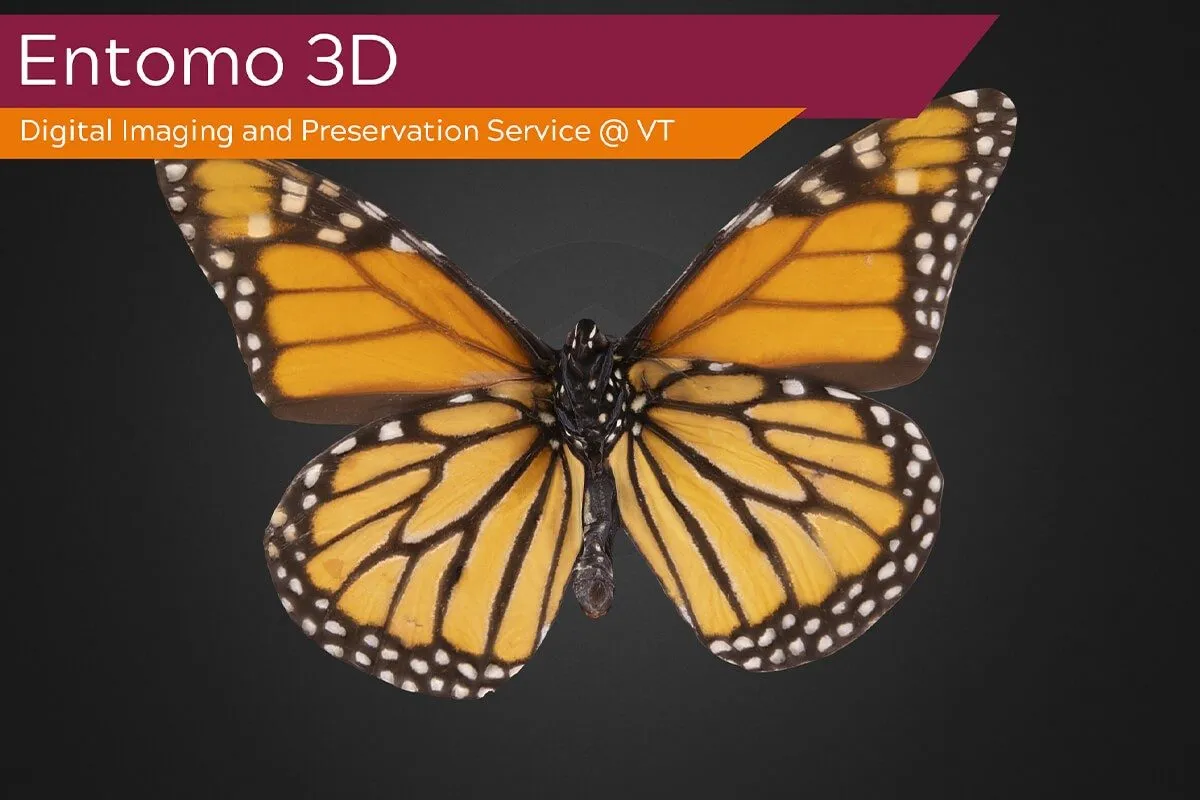
Cover photo courtesy of Maureen Saverot.
Entomo3D is a digital library of 3D insect models built by Virginia Tech University Libraries, the Department of Entomology, and the School of Visual Arts, funded by the Council on Library and Information Resources. The project aimed to digitize as many pollinator models as the budget and timeframe allowed, drawn from the oldest and largest entomological collection in Virginia. Where most online natural history collections offer only photos or illustrations, these photogrammetry-based models let users rotate, zoom, and inspect anatomy in ways a static image can’t — opening the collection to classrooms and museums that would otherwise never see it.
My role was building and running the digitization pipeline that turned raw photographs into finished 3D models. Each specimen started as 300+ photos captured on a motorized turntable by a colleague — harder than it sounds, since insect texture varies wildly: some beetles have a reflective sheen that catches light unpredictably, while many arachnids are furry in ways that make edges hard to resolve. To catch focus problems before they became expensive, I wrote a Python script that ran a first-pass background removal and estimated how usable the eventual model would be, flagging out-of-focus shots early for exclusion.
With a fixed grant budget and at least four people touching every specimen downstream, that automated check meant we weren’t sinking hours of manual touch-up and QA into a shot set that was never going to produce a usable model — it let us get more finished specimens out of the funding we had. From there, a colleague and I split manual touch-up on every photo set, before I ran a scheduling script to batch the actual photogrammetry jobs, extending photogrammetry-automation code originally built for an earlier project, SourceForm. Finished models went through a manual quality pass, before handing off to student artists for retopology and a final metadata check by another colleague.
We processed 300+ specimens over the course of the project; about 150 came out at production quality, and some were published on SketchFab under Creative Commons licensing. That gap is as much a part of the story as the models that did make it: a pipeline that catches a bad photo set early is worth more than one that only looks good on paper and lets failure stay invisible until the end.