Project · January 2022
Celestial Garden
Sixteen touch-reactive, glowing pods hanging in a Smithsonian gallery, built to feel alive even when no one meant to touch them.
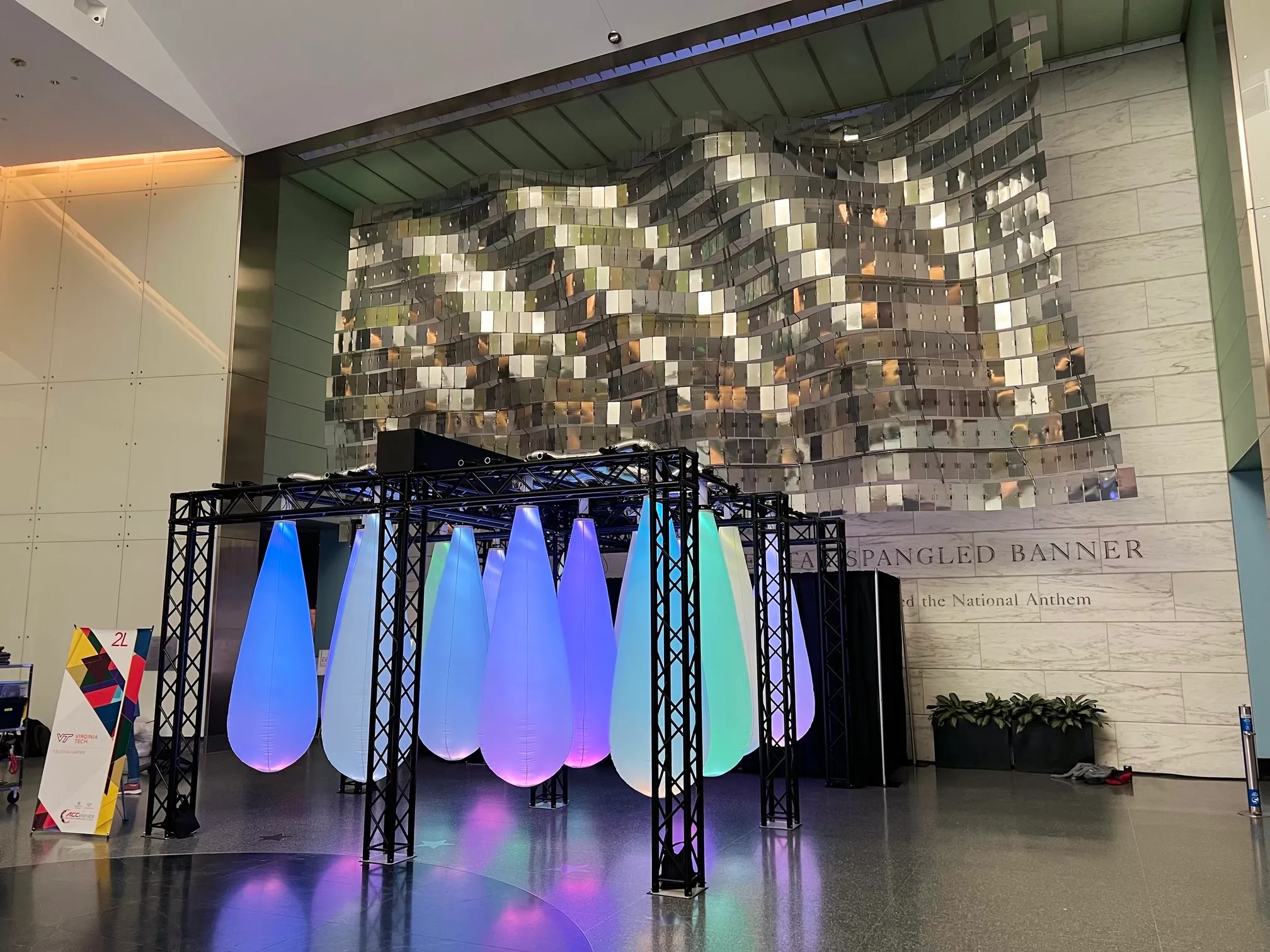
Celestial Garden was an interactive installation exhibited at the Smithsonian National Museum of American History as part of the 2022 ACCelerate Festival, developed through Virginia Tech’s Institute for Creativity, Arts and Technology (ICAT) in collaboration with the School of Visual Arts. Sixteen inflated, teardrop-shaped pods — each fitted with a speaker and an LED light strip — hung from a metal frame and responded in real time to visitor touch, building a dynamic, evolving soundscape and light display as people moved through the space.
I wrote the main Arduino firmware, the interactivity API, and the diagnostics tooling that held the installation together. Each pod ran on a SAMD-based board with an onboard accelerometer for touch sensing and a FastLED-driven light strip, networked over Ethernet with an auto-assigned MAC/IP scheme keyed to each board’s hardware serial number so a pod could be swapped or rebooted mid-exhibit without manual reconfiguration. Sensor and state data streamed out over OSC to a set of Max/MSP patchers I built for real-time diagnostics and to drive the audio layer designed by the exhibit’s sound lead, Tanner Upthegrove — giving the team a live, at-a-glance view of all sixteen pods during the festival’s public run. I also added experimental over-the-air firmware updates, so fixes could ship without pulling a pod off the floor.
The most interesting finding wasn’t planned. During slower hours, pods would occasionally shift color or sound on their own — not from a deliberate touch, but from the draft of someone walking past. That incidental, ambient interaction turned out to be more interesting to me than the intentional kind, and it’s the thread I’ve been pulling on since: my current PhD research uses the same instinct — capturing subtle signals people aren’t consciously producing — to build interfaces for live performance. I also spent shifts on the exhibit floor as a docent, explaining the system to visitors of every age and technical background in real time.